Why short AI-generated scenes are finding a practical role in live-action advertising and branded video
AI video is easy to dismiss. Much of what reaches social media is visibly synthetic, while the strongest work appears beyond the budgets of most agencies and smaller brands. That creates a misleading choice between cheap footage that cannot be used and impressive work that cannot be afforded.
A more useful market is emerging between those extremes. AI is being used to create short, specific scenes that would otherwise be disproportionately expensive, difficult or impossible to produce, then integrated into a wider live-action or conventionally produced film.
The commercial opening is the short scene
Netflix provides the clearest evidence of this shift. In July 2026, the company reported that generative AI workflows had been used in roughly 300 titles, mostly in post-production. Examples included enhanced crowds, historical battle sequences and worldbuilding establishing scenes. Netflix also said some productions would have omitted key footage without generative AI because conventional alternatives exceeded their budgets or schedules (Netflix, Inc., 2026).
An advert may need only a few seconds of a crowded station, a historic street, an inaccessible landscape or a surreal visual metaphor. Conventionally, that might require travel, set construction, extras, animation or substantial visual-effects work. AI creates another option: produce the difficult scene separately and add it in post-production.
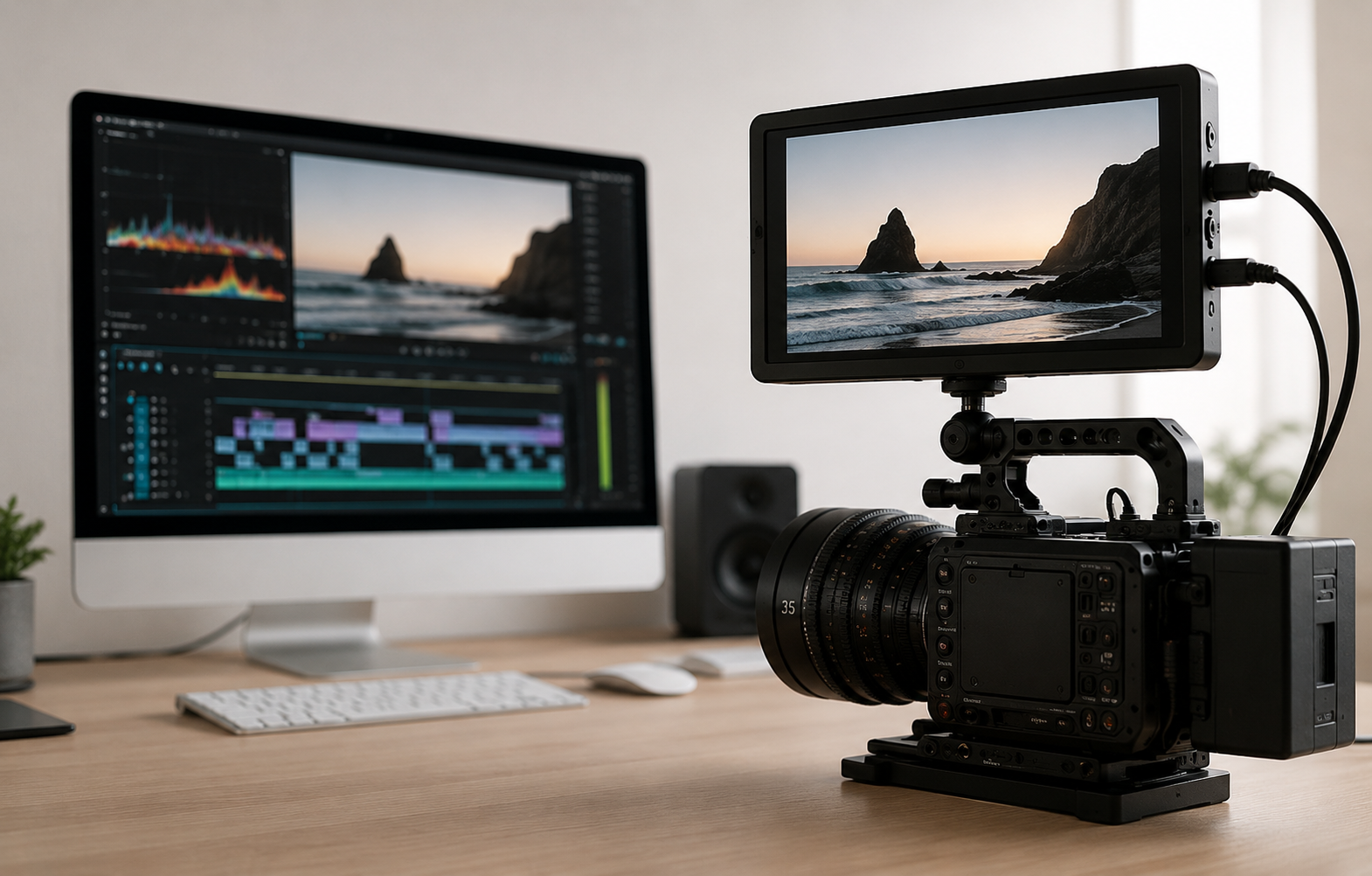
This is hybrid production. The performers, product and central narrative may remain live action. AI is used where it expands what the production can show.
Why this form is gaining acceptance
Short AI-generated scenes solve a defined production problem without requiring the whole film to become an “AI film”. They can be assessed, revised or replaced individually, while the technology supports the creative idea rather than becoming the focus of the viewer’s attention.
Adoption is not governed by technical capability alone. The creative industries have legitimate concerns about authorship, training data, employment, consent and replicated human performances. These concerns now sit inside union agreements and production guidance (SAG-AFTRA, n.d.; Writers Guild of America, 2026).
A bounded scene does not resolve those issues. It offers a more proportionate use case: AI creates clear production value while human direction, performance and editorial judgement remain central.
Why longer generation remains risky
A long, finished video can contain several effective AI-generated scenes. That is different from expecting one continuous generation to sustain convincing characters, environments, movement and narrative coherence.
Research into generative filmmaking still identifies consistency, controllability, fine-grained editing and motion refinement as material challenges (Zhang et al., 2025). As a generated sequence runs longer, visual drift, unstable details, weak physics or unexplained changes in space and scale have more opportunity to emerge.
Long-form generation may improve rapidly. For now, stretching a scene beyond what the models can reliably sustain often exposes the technology rather than serving the film.
Why AI video quality varies so widely
AI video is commonly marketed as a simple prompt-to-video process. Adobe, for example, promotes generation from a text prompt “in just one click”, although its professional workspace includes several models, editing controls and refinement tools (Adobe, n.d.).
That promise obscures the difference between generating a clip and delivering finished commercial work. Poor results often come from an unsuitable use case, weak source assets, novice direction, reliance on one model and insufficient post-production. Current models also have genuine limits, so skill cannot make every concept work.
Bad AI video is not always operator error. But low-skill, single-platform output is too often treated as evidence of the category’s maximum quality.
What studio-grade production actually requires
Different models are stronger at different tasks, including realism, stylisation, character consistency, camera movement, motion quality and sound. Professional production therefore draws on a wider system: research and scripting, storyboarding, image generation, multiple video models, consistency controls, editing, compositing, sound design, restoration, upscaling and commercial review.
Google DeepMind’s ANCESTRA illustrates the principle at the top end. It combined live action with several generative models and developed new capabilities for motion matching and blending generated footage with filmed material (Mathewson, 2025). Netflix’s guidance also asks production partners to consider creative control, data management, intellectual property, consent and content integrity when choosing tools and vendors (Netflix, n.d.).
Mason Analytics has developed this capability through producing a substantial and varied portfolio of AI video. We use a deep, continuously evolving combination of frontier models and specialist production software, selecting the workflow around the demands of each scene rather than forcing every brief through one platform.
The expertise lies in deciding where AI adds value, choosing the right route, recognising weak output quickly and integrating the result into the finished film.
Making high-end capability accessible
Maintaining this capability is expensive. It involves multiple professional platforms, generation costs, discarded iterations, continual testing and conventional post-production skill. That helps explain why much of the best AI video has come from top-tier studios.
Smaller organisations need not accept poor quality. Channel 4’s Smart Ad Engine was created to reduce the production cost, creative complexity and lack of in-house expertise that have prevented SMEs from accessing television advertising (Channel 4, 2025).
Mason Analytics gives agencies, smaller brands and SMEs access to studio-grade AI production through a lean specialist model. A client can commission one complex scene, campaign assets or a complete hybrid production without building and maintaining the capability internally.
What buyers should assess
The test is not whether a supplier has access to a fashionable model. Buyers should look for a varied portfolio of finished work, consistency across scenes, professional editing and sound, experience integrating AI with live action and clear judgement about where AI will and will not improve the result.
AI video is earning a practical place in commercial production by making ambitious scenes achievable within real budgets and timescales. Its value is not the novelty of generated footage. It is creating the scene the brief needs and making it feel as though it was always part of the film.
References
Adobe. (n.d.). Free AI video generator: Text to video online. Retrieved July 29, 2026.
Channel 4. (2025, November 17). Smart Ad Engine: Channel 4 Sales enables SMEs to connect with the power of TV advertising.
Mathewson, K. (2025, June 13). Behind ANCESTRA: Combining generative AI with live-action filmmaking. Google DeepMind.
Netflix. (n.d.). Using generative AI in content production. Netflix Partner Help Center. Retrieved July 29, 2026.
Netflix, Inc. (2026, July 16). Q2 2026 shareholder letter.
SAG-AFTRA. (n.d.). Artificial intelligence resources. Retrieved July 29, 2026.
Writers Guild of America. (2026). 2026 MBA contract changes FAQ.
Zhang, R., Yu, B., Min, J., Xin, Y., Wei, Z., Shi, J. N., Huang, M., Kong, X., Xin, N. L., Jiang, S., Bahuguna, P., Chan, M., Hora, K., Yang, L., Liang, Y., Bian, R., Liu, Y., Campillo Valencia, I., Morales Tredinick, P., . . . Rao, A. (2025). Generative AI for film creation: A survey of recent advances [Preprint].